So... I Started Another Game

Game Dev: So... I Started Another Game
So...
I did it again.
I started another game.
In my defense, I really just wanted to mess around with Unity again, see what's changed, and get back into developing without constantly worrying about whether adding one more image is going to cause some tiny piece of hardware to explode.
It was supposed to be experimenting.
Apparently I experiment by making games.
This One Actually Started Years Ago
The idea isn't entirely new.
Back during the Infinity Game Table days, I had started working on a digital board game inspired by Rock Paper Switch.
My version was designed as a four-player digital game built around the familiar Rock-Paper-Scissors relationship, with an additional piece thrown in to add another layer of strategy.
I got a decent way into the idea.
Then I got bored with it.
Part of that was simply me having another idea I liked better, but development on the IGT side was also becoming increasingly frustrating. I was trying to decide which projects were actually likely to make it through the approval process, and this one eventually got pushed aside.
Instead, I moved on to Acros, an acronym-based party game that used players' mobile devices as controllers.
That seemed like a better project to pursue for the platform.
Then things in the IGT development channels started getting quieter.
And quieter.
Then came the acquisition.
And, as we all know, that was pretty much the end of the Infinity Game Table as a development platform.
Still a shame.
So the original Rock-Paper-Scissors project joined the collection of ideas sitting around waiting for me to eventually remember they exist.
Against My Better Judgment...
Fast-forward to now.
After spending so much time developing for the WOWCube and constantly working around its limitations, I've been getting curious about jumping back into Android development.
Which means returning to Google Play.
Against my better judgment.
I opened Unity intending to look around, see what's changed, refresh my memory and maybe do a little experimenting.
Then I remembered that old game.
What if I took the basic Rock-Paper-Scissors strategy...
Added some new mechanics...
Ditched the old theme...
Turned it into a fantasy battle...
And rebuilt the entire thing around that?
Well...
Meet Threefold: The Last Stand.
Rock, Paper, Scissors... With Swords
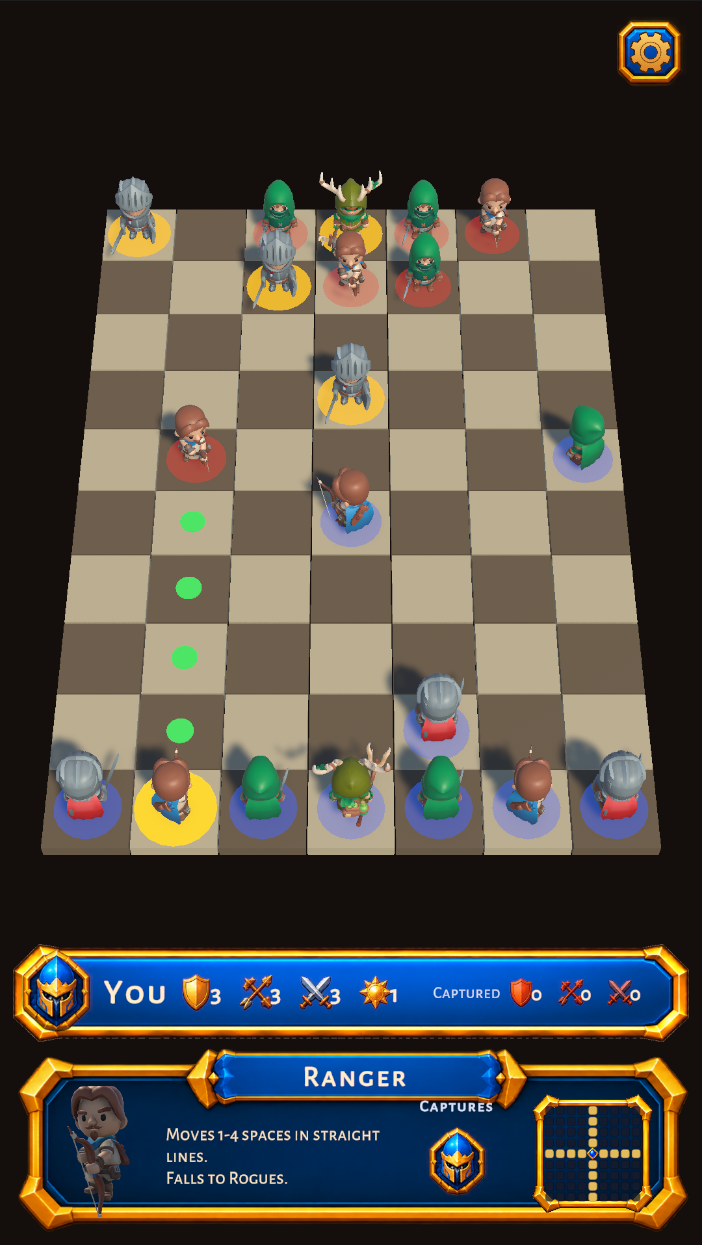
At its core, Threefold is a fast-paced fantasy strategy game built around Rock-Paper-Scissors combat.
Instead of rocks, paper and scissors, you're commanding Paladins, Rangers and Rogues.
Each class has its own movement and capture relationships, so positioning and understanding what can defeat what becomes the heart of the game.
But there's also a fourth piece:
The Priest.
And that's where things start getting considerably more interesting.
The Priest Changes Everything
The Priest isn't simply another combat piece.
Depending on the battlefield, Priests can activate magical Shrines that provide tactical advantages to their side.
They can hunt dangerous Undead.
And they can perform one of the game's most expensive abilities:
Resurrection.
A Priest can sacrifice their own life to return a captured warrior to the battlefield.
That means bringing back exactly the piece you need might also mean giving up one of the most strategically useful pieces you have.
But the Priest has one more trick.
If your forces start falling and you completely lose one of your primary classes, your Priest can become your Last Stand.
They can take on the role of the missing class and keep you in the fight just a little longer.
So do you keep your Priest safely tucked away?
Send them after a Shrine?
Risk them against the Undead?
Sacrifice them to resurrect a captured warrior?
Or protect them because they may eventually be the only thing keeping you alive?
That's the kind of decision I want Threefold to create.
Yes, I'm Using AI
I'm also using AI for a lot of the programming on this one.
Why?
Because I can.
I'd be an idiot to turn down a programming tool that can speed up development and let me spend more of my time on the parts of the game I actually care about.
End of story.
The game design is mine.
The rules are mine.
The interactions are mine.
A lot of the implementation is still hand-coded by me.
But I'm not going to spend hours writing boilerplate code just so I can proudly say I typed every character myself.
I'd rather spend that time designing another mechanic, balancing a rule, building a level, or actually playing the game.
I Also Don't Prototype Like a Normal Person
Some of the UI and artwork currently in the game is AI-generated placeholder art.
And that's intentional.
A lot of developers are perfectly happy prototyping a game using cubes, spheres and colored rectangles.
I've never been particularly good at that.
I need to be able to feel the game.
If I'm staring at a gray box sliding toward another gray box, I have a hard time seeing the finished product in my head.
Give me an actual battlefield, characters, buttons and something resembling the final visual direction, and suddenly I can tell whether the whole thing is working.
So I tend to work on the art, UI and overall feel much earlier than you're probably supposed to.
It's not necessarily the correct way to prototype.
It's just the way that works for me.
And It's Already Playable
So far, development has been moving surprisingly quickly.
Piece movement is working.
Capturing is working.
The basic gameplay loop is working.
And, as usually happens, the rules have continued evolving as I've actually implemented and played them.
Something that sounds perfect on paper doesn't always survive contact with an actual game board.
That's part of the fun.
More importantly...
It's actually fun to play.
That's generally a useful feature.
Where Threefold Could Go
Right now, I'm planning Threefold primarily as a single-player game against an AI opponent, with a collection of themed levels rather than simply playing the exact same board repeatedly.
And that's where the possibilities start opening up.
Some battlefields may contain obstacles that change how you move around the board.
Others may contain Shrines that can provide an advantage, but only if your Priest can reach and control them.
Some could have independent monsters wandering around the battlefield, attacking either you or the AI.
Undead can create another threat entirely.
Different layouts can force different strategies.
Different combinations of those mechanics can turn the same basic rules into very different battles.
There's a lot I can do with it.
And after spending so much time thinking about whether I have enough memory or package space to add another feature...
It feels really good to be able to say that again.
What About Monetization?
No idea.
Seriously.
I don't know yet.
Maybe it'll be a paid game.
Maybe there will be another model that makes sense.
Maybe I won't monetize it at all.
That's a decision for later.
Right now I'm much more interested in answering the important question:
Is the game fun?
So far, the answer seems to be yes.
And that's enough reason to keep building it.
Apparently This Is What "Taking a Break" Looks Like
So JOFD is still sitting there waiting for its final work.
SLOA is still sitting there waiting for me to come back.
I said I wanted to start experimenting with Android again.
And somehow that turned into resurrecting an abandoned IGT project, completely retheming it, adding new mechanics, designing a Priest system, planning AI opponents, Shrines, Undead, Resurrection and themed battlefields.
So...
Pretty standard week around here.
Threefold: The Last Stand is officially underway.
Now it's back to the gameplay.

Comments
No comments yet. Say something!